
ADAPTED FOR THE SILVER SCREEN
Actor-director Ian Dixon is convinced the nascent Singapore film scene has the potential to go a long way – by heading down the unconventional route.
Speak of pursuing filmmaking in Singapore, and one would generally be advised to leave the country for greener pastures. In the eyes of director Ian Dixon, however, there is no better place to be – the republic’s film industry is exciting, if small.
“Singapore is not locked down by conventions like the United States, England and France are,” the 53-year-old told us over tea. His family moved up to the island city back in November last year, when he picked up the lecturing job.
“The film industries of every other country I’ve worked in – Australia, South Korea, United States and England – is a closed shop,” he lamented, “So it doesn’t matter if your industry is small or big. What matters is how you use the backdoor to get inside.”

An associate professor at Wee Kim Wee School of Communication and Information (WKWSCI) in Nanyang Technological University (NTU), the former actor and father of one has his foot firmly planted in the local filmmaking sphere with a number of productions in the pipeline.
One such project he shared was a science fiction-thriller feature film, Mad Bots, in the works with Beach House Pictures, an independent production company based in Singapore. While science fiction is not a genre one would think of when talking about locally produced flicks, Dixon believes that Singapore is the perfect place for it – particularly the university where he lectures.
“Singapore is famous for its architecture, but when I look at NTU, it’s like the place has just gone a little bit south,” he said with a laugh, “To me, it looks like the future.”
This mindset has shaped his view of the local movie field as well, which he has in turn brought with him to the classroom as WKWSCI undergraduates prepare to enter the local and international market. This is, of course, not his first educational rodeo – alongside his more than 25 years of experience as an actor and director, he had also taught cultural studies, film theory and a variety of other courses at Deakin University, University of Melbourne, RMIT University and SAE Institute.
At WKWSCI, he teaches two courses: Screenwriting, and Acting and Directing for Television and Film.
“I have had students at WKWSCI thank me for creating a safe place to experiment in class,” he told us proudly, “It’s when people experiment on film that they start to shake up the cliches and formulas of the past.
“As (the students) improvise, they discover the conventions necessary for filmmaking.”
“WE’RE LOOKING AT WORLD-CLASS SCRIPTS (IN CLASS) AND I WANT TO SEE THEM MADE.”
– Associate Professor Ian Dixon, about his students at WKWSCI
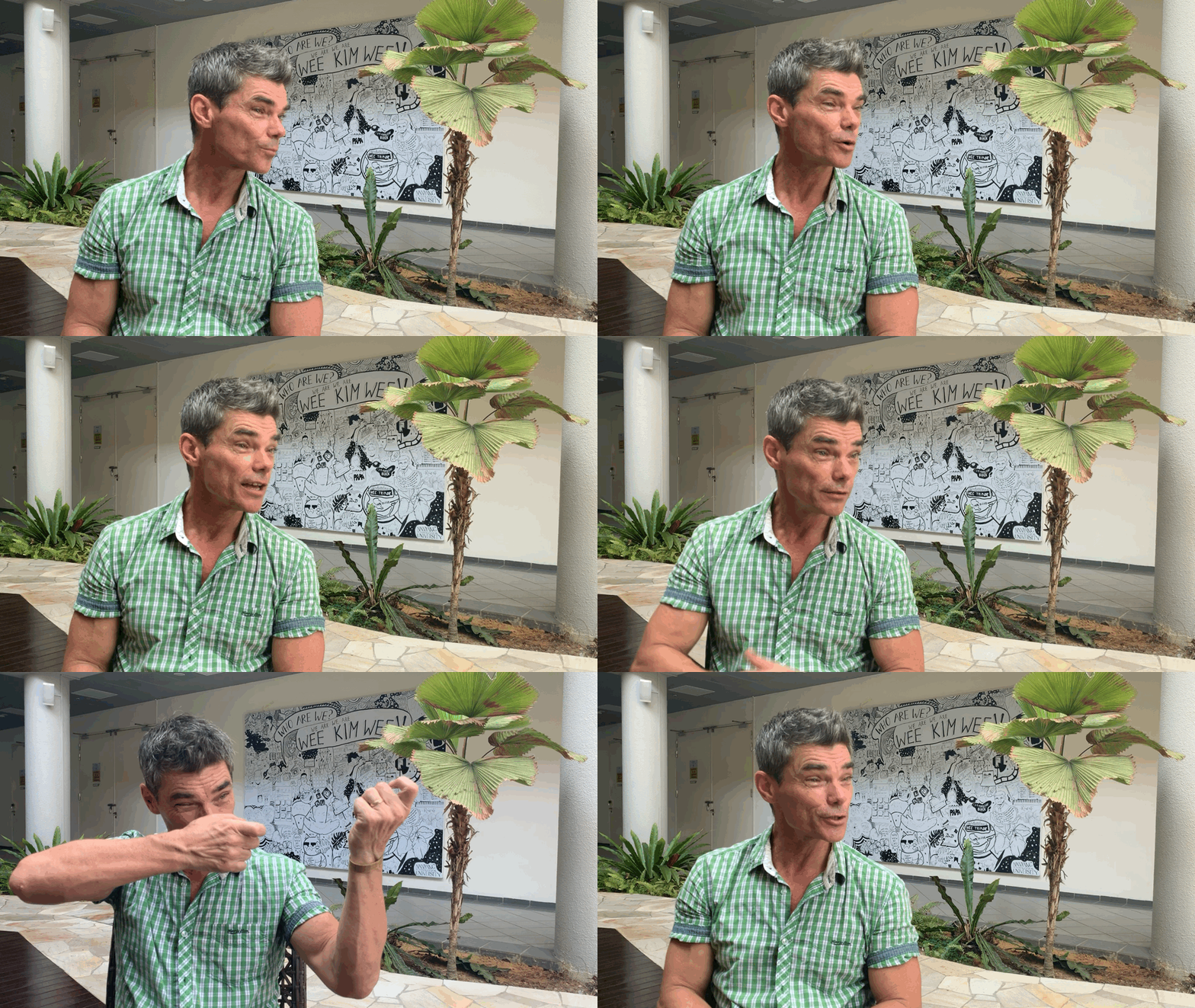
While his classes have been well-received, the associate professor was candid about his fears when he moved to a new environment a year back, with no prior experience in the Singapore film industry. To adjust, he read up extensively through academic journals, and arranged meetings with local production companies and international corporations based in Singapore – and came to the conclusion that the Lion City’s offerings have the capacity to be bigger than what it is today.
He raised an example in Thai cinema, which has been making “groundbreaking films” that headline various international film festivals. According to Dixon, Thailand had no film industry and created theirs from the ground up – and he believes Singapore is in the prime position to follow suit, as the next generation of filmmakers and talents heads out into the industry.
His course in screenwriting has led to the formation of a “writer’s room”, where students have been able to workshop ideas and have them come together to make a single production – “Like with Netflix,” he said proudly, with a grin.
“Most of what you see out there are from writer teams who throw out risky ideas together to make a single production,” he explained, “And to have these students comfortable working with their crusty, old professor in this way is quite a compliment in itself.”
